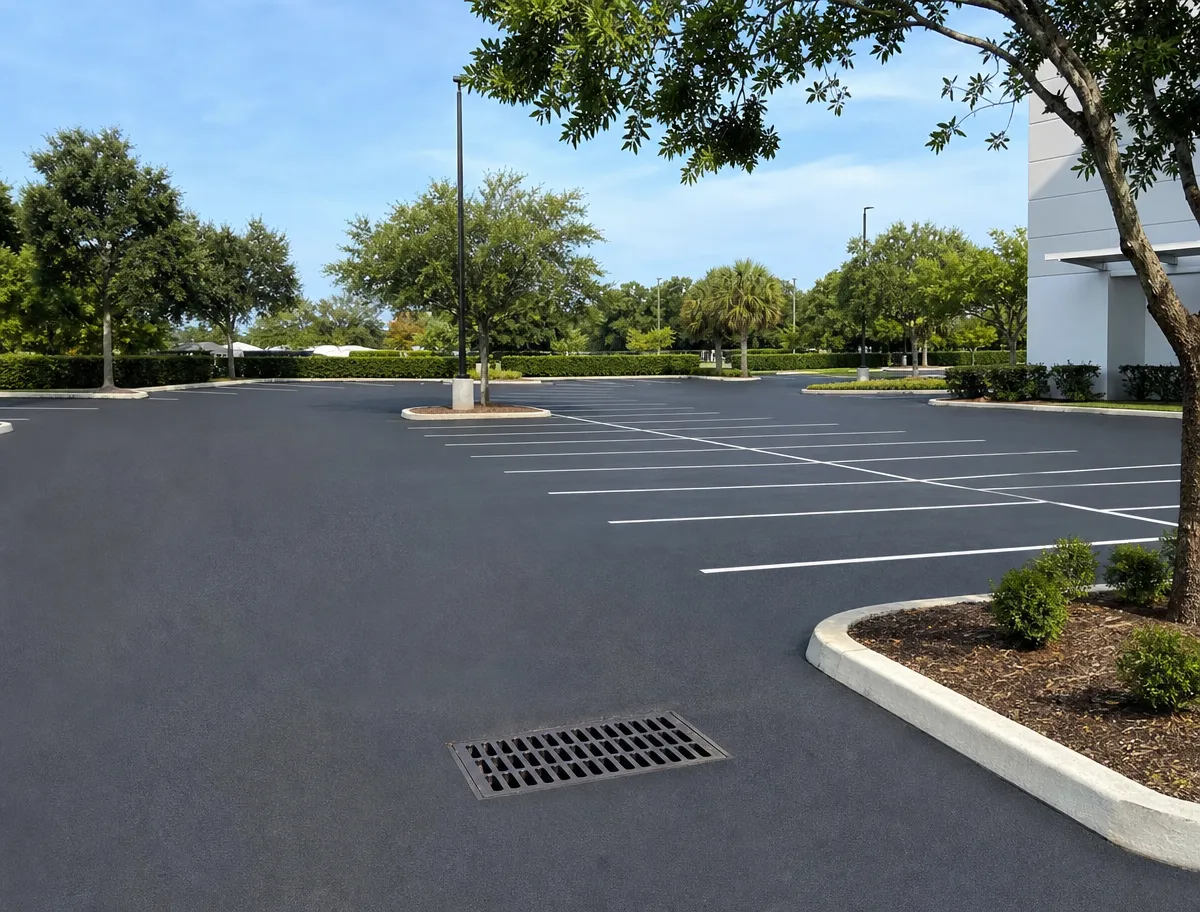
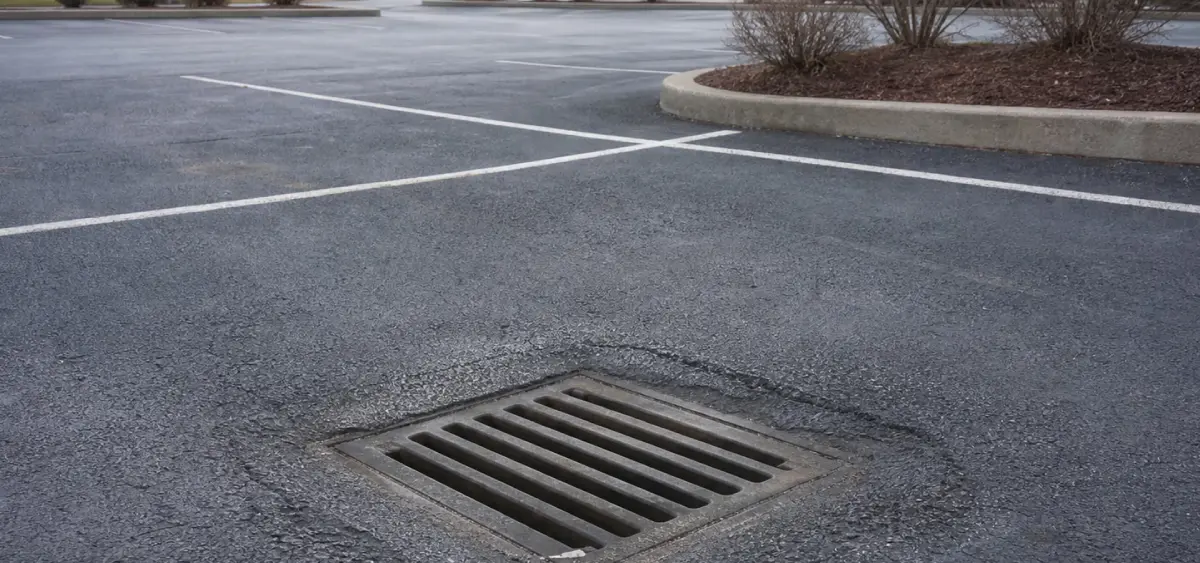
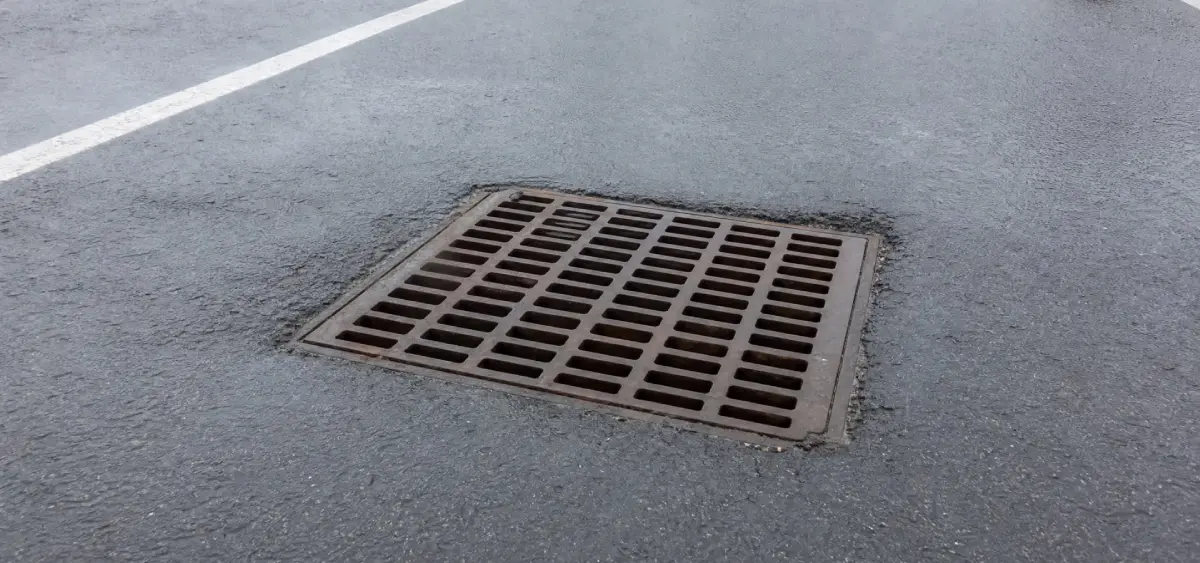
Quick Answer: Most commercial parking lots in Northeast Ohio should be sealcoated every 2–4 years. High-traffic properties — retail centers, restaurants, medical facilities — need it every 2 years. Lower-traffic properties such as office parks or storage facilities can extend to every 3–4 years. In the Cleveland area, the most important function of sealcoating is waterproofing: a sealed lot resists the water infiltration that causes freeze-thaw damage, which is the primary way asphalt deteriorates in this climate.
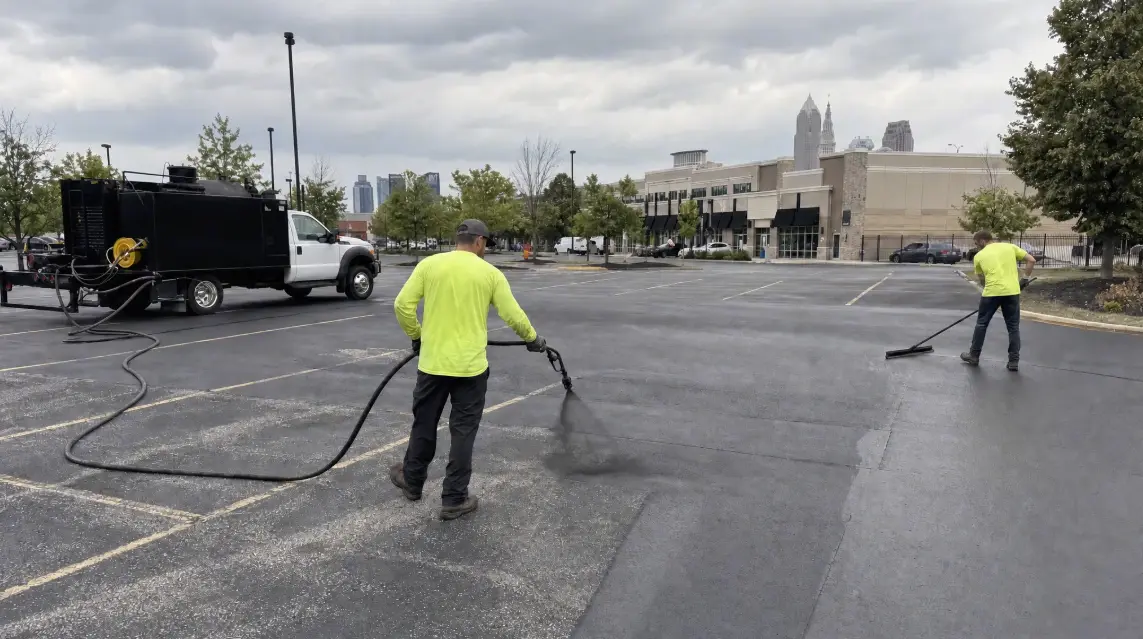
Property managers and facility owners in Northeast Ohio ask about sealcoating schedules for one of two reasons: either their lot is visibly oxidizing and they want to know if it is too late, or they are trying to set up a maintenance calendar that prevents that from happening.
The 2–4 year guideline is real and it applies to most commercial lots in the Greater Cleveland area. But the right interval for your specific property depends on four variables that this guide covers in detail: traffic volume, asphalt age and condition, existing sealcoating history, and exposure to fuel and chemical spills.
It also covers the Cleveland application window — the specific weather conditions required for sealcoating to bond and cure correctly — and what Empire Paving includes in a commercial sealcoating assessment.
What Does Sealcoating Actually Do for a Commercial Parking Lot?
Before covering frequency, it is worth being precise about what sealcoating does — because the answer determines why the schedule matters.
Asphalt pavement is a mixture of aggregate (stone and sand) held together by bituminous binder — a petroleum-derived material. The binder is what gives asphalt its flexibility, its dark color, and its ability to handle load and temperature cycling. It is also what deteriorates over time.
Two forces attack the binder continuously:
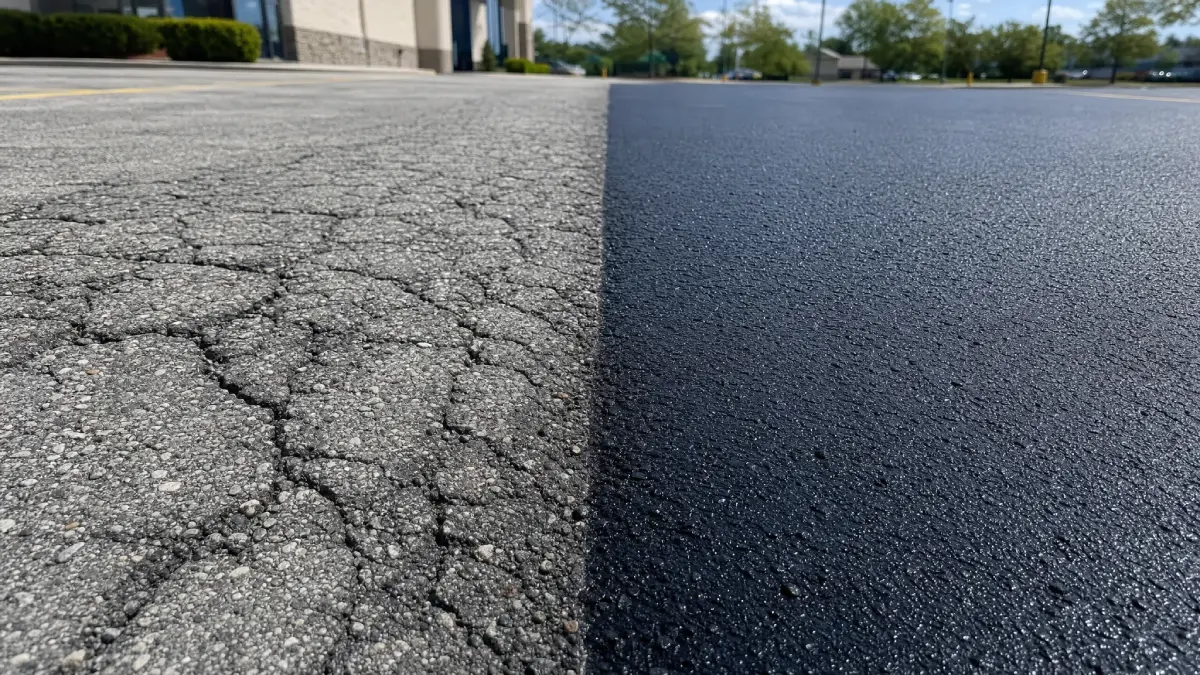
- UV oxidation: Sunlight breaks down the chemical bonds in the asphalt binder year-round. In Northeast Ohio, the combination of summer UV intensity and winter reflective sun off snow and ice accelerates this process. As the binder oxidizes, the asphalt becomes brittle, fades from black to gray, and loses its ability to flex without cracking.
- Water infiltration: Once the surface oxidizes and micro-cracks develop, water enters the pavement structure. In Cleveland, that water freezes and expands in winter — generating forces that widen cracks, heave the surface, and destabilize the base. The freeze-thaw cycle is the dominant mechanism of asphalt deterioration in Northeast Ohio. Sealcoating is the primary defense against it.
Sealcoating applies a protective layer — coal tar emulsion or asphalt emulsion — over the surface that:
- Blocks UV radiation from reaching the asphalt binder
- Creates a waterproof barrier that prevents water infiltration into the pavement structure
- Restores surface flexibility, slowing further oxidation
- Refreshes the surface appearance and extends the visible life of the lot
What sealcoating does not do: repair existing cracks or structural damage. Cracks must be filled before sealcoating — sealcoat applied over open cracks does not bridge them and provides no structural benefit. This sequencing matters when planning a maintenance program.
How Often Should Most Commercial Lots in Northeast Ohio Be Sealcoated?
The standard industry recommendation for commercial sealcoating intervals in a northern climate like Cleveland is every 2–4 years. The table below maps property type to recommended interval:
| Property Type | Recommended Interval | Reason |
|---|---|---|
| Retail strip centers, big-box retail | Every 2 years | High traffic volume; constant turning and braking accelerates sealcoat wear |
| Restaurants and fast food | Every 2 years | High traffic + fuel/oil drips from vehicles degrade sealcoat faster |
| Medical facilities, urgent care | Every 2 years | High drop-off/pickup traffic; liability concern from surface deterioration |
| Office parks (moderate traffic) | Every 2–3 years | Moderate traffic; standard wear pattern |
| Industrial facilities | Every 2–3 years | Heavy vehicle loads stress the surface; fuel exposure common |
| Self-storage facilities | Every 3–4 years | Low traffic volume; slow sealcoat wear |
| Church parking lots | Every 3–4 years | Intermittent use; surface exposed to UV but low abrasion wear |
💡 Pro Tip: These intervals assume the lot received its previous sealcoating within the recommended window. A lot that is already several years overdue for sealcoating needs a condition assessment before a schedule is applied — the prep requirements for a heavily oxidized lot are different from a lot that is simply due for its next scheduled coat.
What Factors Have the Biggest Impact on How Frequently Your Lot Needs Sealcoating?
- Traffic volume and type
Traffic is the primary wear mechanism for sealcoat. Every vehicle that turns, brakes, or parks on the surface abrades it. High-volume lots with consistent daily traffic — a grocery store, a pharmacy drive-through, a busy office complex — wear through sealcoat faster than a lot that sits mostly empty on weekdays. Heavy vehicles (delivery trucks, garbage haulers, emergency vehicles) accelerate wear further.
- Age and condition of the existing asphalt
A well-maintained lot that is four years into its life with one prior sealcoating behaves very differently than a lot that was last touched when the building was constructed 15 years ago. Older asphalt has more accumulated oxidation, more existing crack propagation, and less residual binder flexibility. These lots may need more frequent attention — or may need crack filling and resurfacing before sealcoating makes economic sense.
- Previous sealcoating history
A lot that has never been sealcoated — or one that went 8–10 years without treatment — is likely heavily oxidized asphalt with significant binder loss. Applying sealcoat directly to this surface without prep typically results in poor adhesion and premature failure. A rejuvenating primer or crack filling may be required first. A professional condition assessment identifies the right prep sequence before the first coat goes down.
- Fuel and chemical exposure
Petroleum products — gasoline drips, engine oil, hydraulic fluid — attack both the asphalt binder and the sealcoat layer. Lots with a high proportion of vehicles that idle or park in the same areas repeatedly (drive-throughs, delivery zones, fuel islands) experience accelerated sealcoat degradation in those zones specifically. These properties typically need the shorter end of the 2–3 year interval, and spot attention to high-exposure areas between full applications.
Why Does Northeast Ohio’s Freeze-Thaw Cycle Make Sealcoating More Critical Here?
Northeast Ohio’s climate is among the most demanding for asphalt pavement in the continental United States. The Cleveland area experiences an average of 80–100 freeze-thaw cycles per year — days where temperatures cross the 32°F threshold in both directions. Each cycle puts mechanical stress on the pavement:
- Water that has infiltrated the asphalt surface freezes and expands by approximately 9% in volume
- This expansion exerts upward pressure on the pavement surface, widening existing micro-cracks
- When temperatures rise and the water thaws, the expanded crack collapses — but not back to its original size
- Each successive freeze-thaw cycle makes the crack incrementally larger
- Eventually the crack allows water to reach the base, which destabilizes the pavement structure and leads to pothole formation
The math is straightforward: a sealcoated lot that resists water infiltration experiences significantly less freeze-thaw damage than an unsealed lot where water enters freely through oxidation cracks. Over a 10-year horizon, the sealcoated lot requires less crack repair, less patching, and a later resurfacing date.
This is why the cost comparison between regular sealcoating and deferred maintenance consistently favors sealcoating: a resurfacing project on a 50,000 sq ft commercial lot in Northeast Ohio runs $100,000–$300,000+ depending on existing condition. Regular sealcoating at $15,000–$30,000 every 2–3 years extends the resurfacing interval significantly and reduces the total life-cycle cost of the pavement.
💡 Pro Tip: Empire Paving’s parking lot maintenance program is specifically structured around Northeast Ohio’s climate — scheduling crack filling, sealcoating, and resurfacing in the sequence that maximizes pavement life for Cleveland-area commercial properties.
What Is the Best Time of Year to Sealcoat in the Cleveland Area?
Sealcoating is temperature-sensitive. The application requires specific conditions to bond and cure correctly — conditions that are not available year-round in Northeast Ohio.
The reliable application window for the Greater Cleveland area is late May through September.
The requirements:
- Ambient temperature above 50°F at the time of application
- Pavement surface temperature above 50°F (pavement heats and cools differently than air — check the surface directly)
- No rain forecast for at least 24 hours after application
- Humidity below 90% — high humidity slows cure time and can affect surface finish
- Direct sunlight preferred — curing is faster and more complete in sun than in shade
What happens outside this window:
- April application: Nights in April in Cleveland regularly drop to the mid-30s. Sealcoat applied when pavement is still cold cures improperly, bonds weakly, and may peel within the first season.
- October application: October weather in Northeast Ohio is unpredictable. An application window that looks fine on Monday can turn cold and wet by Wednesday. Late-season applications carry meaningful risk of failure.
- Early or late in the window: Late May and early September are viable but require monitoring the forecast more carefully than mid-summer applications. A 48-hour rain forecast after application is the most common cause of sealcoating failure at the edges of the season.
| Month | Sealcoating Viability | Notes |
|---|---|---|
| April | Not recommended | Night temps regularly below 50°F; cure risk high |
| May (late) | Viable with monitoring | Watch overnight temps; confirm forecast closely |
| June–August | Optimal | Reliable temps, low rain risk; ideal window |
| September | Viable with monitoring | Earlier in month is better; watch forecast |
| October | Not recommended | Unpredictable temps; significant failure risk |
💡 Pro Tip: The July–August window books up fastest for commercial sealcoating in Northeast Ohio. Property managers who wait until the lot looks bad in late summer often find contractors are backlogged. Scheduling your assessment in spring — even if the work is planned for summer — secures your place in the schedule and allows time for any crack filling to be completed before the sealcoating crew arrives.
What Happens to a Parking Lot That Goes Too Long Without Sealcoating?
The deterioration sequence on an unsealed or under-maintained commercial lot in Northeast Ohio follows a predictable pattern:
- Years 1–3: Surface begins to oxidize and fade from black to gray. Micro-cracks develop but are not yet visible. Sealcoating at this stage is maintenance — the most cost-effective intervention.
- Years 3–5: Oxidation is visible. Surface has turned gray. Fine cracking (alligator cracking precursors) is appearing in high-stress zones. Sealcoating is still effective but crack filling is now required first.
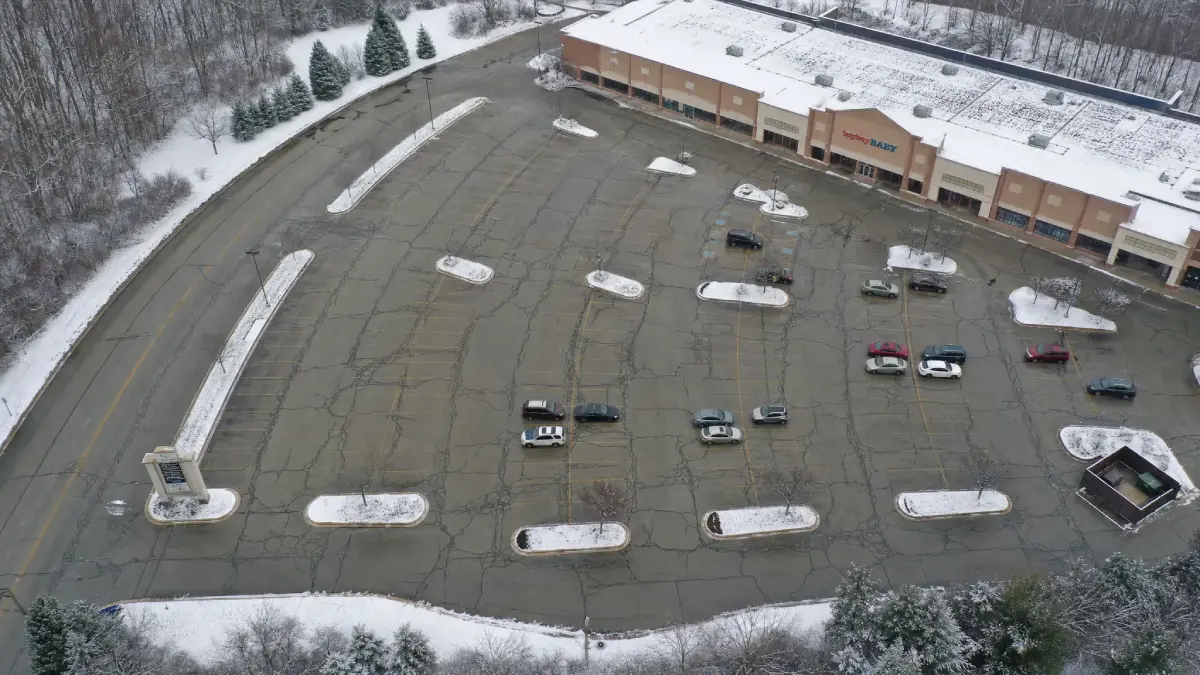
- Years 5–8: Alligator cracking has developed in multiple zones. Water infiltration has begun at crack locations. Freeze-thaw damage is accelerating. Sealcoating alone is no longer sufficient — sections require patching or mill-and-fill before any surface treatment.
- Years 8+: Significant structural damage. Potholes developing. Base saturation likely in affected zones. At this stage the conversation has shifted from maintenance to resurfacing or reconstruction.
The cost at each stage increases exponentially. Catching a lot at years 3–5 costs a fraction of addressing it at years 8+.
What Does Empire Paving’s Commercial Sealcoating Assessment Include?
Empire Paving is a Northeast Ohio commercial and industrial paving contractor based in Cleveland, serving property managers, facility owners, and commercial developers across Cuyahoga, Lake, Geauga, Summit, and surrounding counties.
A commercial sealcoating assessment with Empire Paving includes:
- Pavement condition evaluation: Visual and structural assessment of the existing lot — oxidation level, crack inventory, base condition indicators, drainage evaluation
- Sealcoating schedule recommendation: Based on traffic volume, existing condition, previous maintenance history, and exposure factors — a specific recommendation for interval and timing
- Pre-sealcoating prep identification: Documentation of any crack filling, patching, or structural work needed before sealcoating to ensure proper adhesion and performance
- Application window planning: Coordination of the application schedule within the late May–September window, with specific attention to forecast conditions for the planned application dates
- Written estimate: Complete scope and pricing before any work is committed
Empire Paving serves commercial properties throughout Greater Cleveland and Northeast Ohio. Free assessments are available. Call (216) 581-1000 or request an assessment online.
TL;DR: Commercial Sealcoating in Northeast Ohio — Key Numbers
- Most commercial lots in Northeast Ohio: sealcoat every 2–4 years
- High-traffic properties (retail, restaurant, medical): every 2 years
- Lower-traffic properties (office parks, storage): every 3–4 years
- Application window in Cleveland: late May through September — above 50°F for 24 hours after application
- Never-sealcoated or heavily oxidized lots need condition assessment and likely crack filling before first application
- Fuel/chemical exposure zones wear faster — expect the shorter end of the interval
- Empire Paving provides free commercial sealcoating assessments throughout Northeast Ohio — call (216) 581-1000 to schedule.
Frequently Asked Questions
How often should a commercial parking lot be sealcoated in Northeast Ohio?
Most commercial lots in Northeast Ohio should be sealcoated every 2–4 years. High-traffic properties every 2 years; lower-traffic properties every 3–4. Cleveland’s freeze-thaw cycle makes the waterproofing function of sealcoating especially critical — water infiltration is the primary mechanism of asphalt deterioration here.
What is the best time of year to sealcoat in Cleveland?
The reliable application window is late May through September — when ambient and pavement temperatures stay above 50°F for at least 24 hours after application with no rain forecast. Applications outside this window risk improper cure and premature peeling.
What happens if you sealcoat too often?
Sealcoating too frequently causes buildup that eventually cracks and flakes in large sections. The minimum interval between applications is 12–18 months. For most commercial properties, the optimal interval is 2–4 years based on traffic and condition — not an annual schedule.
Does a never-sealcoated parking lot need special prep before its first sealcoating?
Yes. A heavily oxidized lot likely needs crack filling and possibly a rejuvenating primer before sealcoating to ensure adhesion. Applying sealcoat directly to severely oxidized asphalt without prep typically results in premature failure. A professional condition assessment identifies what prep is needed.
Does Empire Paving do commercial sealcoating in Northeast Ohio?
Yes. Empire Paving provides commercial sealcoating assessments and services throughout Cleveland and Northeast Ohio — evaluating pavement condition, recommending the correct schedule, and coordinating application in the appropriate weather window. Free estimates available at (216) 581-1000.
Related Guides
- Parking Lot Maintenance
- Sealants and Coatings
- Crack and Joint Fillers
- Asphalt Repair
- Asphalt Resurfacing
- Asphalt Patching
- Commercial Paving
Schedule a Free Commercial Sealcoating Assessment for Your Northeast Ohio Property
A sealcoating schedule that is set up correctly — timed to the lot’s traffic and condition, applied in the right weather window, with proper crack filling done first — protects a significant capital asset at a fraction of what deferred maintenance costs.
Empire Paving serves commercial property managers and facility owners throughout Greater Cleveland and Northeast Ohio. Whether your lot is on a regular maintenance schedule, years overdue, or you have never had a professional assessment, the starting point is a condition evaluation that tells you exactly where you stand and what the right next step is.
Call (216) 581-1000 or request your free sealcoating assessment online. Empire Paving operates from Cleveland and serves commercial properties across Cuyahoga, Lake, Geauga, Summit, and surrounding Northeast Ohio counties.
About Empire Paving | Empire Paving is Northeast Ohio’s trusted commercial and industrial asphalt paving contractor, headquartered in Cleveland at 4620 Johnston Pkwy. Specializing in parking lot maintenance, asphalt repair, resurfacing, milling, commercial paving, and sewer and drainage solutions, Empire serves property managers, facility owners, and commercial developers across Cuyahoga, Lake, Geauga, Summit, and surrounding counties. Free estimates — call (216) 581-1000.